Rachio
- 4.8
- Rating
- 500.00K
- Installs
- Free
- Price

 Analysis by App-foxy
I found Rachio most useful when I stopped thinking of it as another weather app and treated it as a control center for an automated watering system. It belongs to the House & Home category, is developed by Rachio, and is free to install. In my experience, that starting price makes it easy to explore, but the real question is whether its connected watering approach fits your garden, controller, and expectations.
The app is aimed at people who want less guesswork around lawn and garden watering. Instead of relying on a timer that runs the same way every week, I would use it to organize watering around the needs of a home landscape. That can be valuable for someone who travels, forgets routine outdoor chores, or wants a clearer way to manage several planting areas.
How Rachio fits into everyday watering
I find Rachio easiest to judge by the everyday decisions it can take off your plate, rather than by the promise of automation alone. The useful question is whether a connected watering routine can make your yard simpler to manage without making you less attentive to it. That balance matters most when you decide how to set up and supervise the system.
You May Also Like

 Blood Strike: 2.5 Anniversary
Blood Strike’s Loadouts Turn Every Drop Into a Tactical Gamble
A close look at Blood Strike’s custom loadouts: how fast access to signature weapons reshapes its battle royale rhythm, rewards preparation, and narrows the gap between fights.

 Pandora - Music & Podcasts
Pandora’s Music Is Easy to Start, but Harder to Recover
Pandora’s strength is its low-effort path from a seed to a station. Its weak spot is how much confidence it asks you to place in connection, setup, and quiet recovery.

 8 Ball Pool
 Is Built on Rivalries, Rematches, and Routine
A close look at the rivalries, rematches, shared routines, and unanswered safety questions that turn a quick pool match into a persistent mobile community.

 Samsung Music
’s Quiet Strength Is Playing What You Already Own
Its reach comes less from spectacle than from dependable access to a personal library. That simplicity is both the app’s strongest retention engine and its ceiling.

 AccuWeather: Weather Radar
AccuWeather Review: A Quick, Clear Forecast for Everyday Decisions
For everyday plans, the best forecast is the one you can understand quickly. AccuWeather makes rain timing, radar, and local conditions easy to act on, with a few trade-offs.

 Hill Climb Racing
Why Hill Climb Racing Still Turns Crashes Into One More Run
A tiny car, a bumpy hill and one more upgrade: Hill Climb Racing keeps resurfacing because its simple chaos makes every near-miss feel personal.
More From Our News Desk



The free starting point and the paid-value question
Rachio is listed as a free app, so downloading it does not require an upfront payment. That matters because you can assess whether the interface and connected setup suit you before committing money to the experience. The app also includes in-app purchases priced from $29.99 to $49.99 per item, so “free” should be understood as free access to the app itself rather than a promise that every possible part of the Rachio experience costs nothing.
I appreciate that distinction because watering control is not a one-size-fits-all purchase. If you already have the compatible Rachio equipment needed for your setup, the app can become a practical way to manage it. If you only want a simple reminder to drag out a hose, paying for connected hardware or optional app items would be difficult to justify. The free download is useful for investigating the workflow, but it does not automatically turn a conventional sprinkler system into a smart one.
The app has been available since May 14, 2014, and its current version is 4.21.14. It supports Android 8.0 and later, which is helpful for people using an older but still serviceable phone. Its Everyone content rating also makes sense for a household utility: I would have no concern about a family member opening it to check watering activity or adjust a routine, although the practical controls should still be handled by the person responsible for the irrigation system.
What I found useful in the actual workflow
My favorite part of this kind of app is not the novelty of pressing a button from a phone. It is the ability to move watering decisions away from a fixed mechanical schedule. A basic timer may run for the same duration whether the ground is already damp or the weather has changed. Rachio is more interesting when the goal is to make watering feel responsive rather than repetitive.
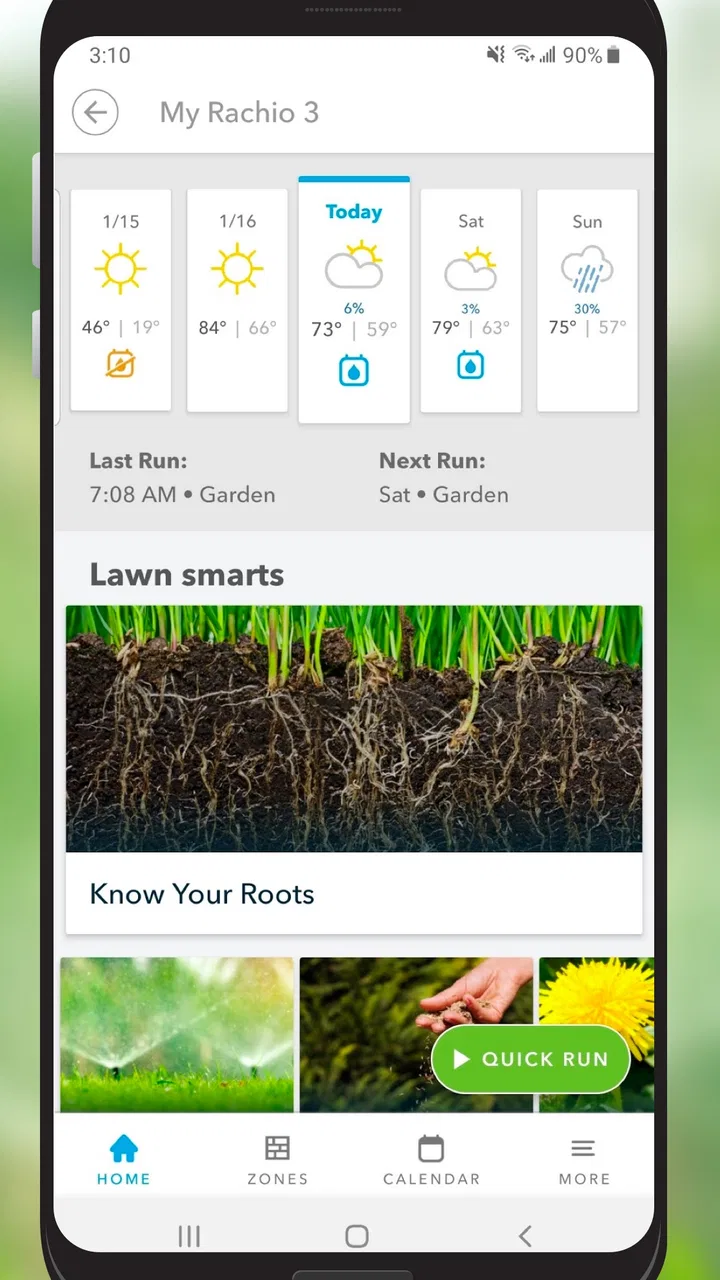
A realistic example is a homeowner leaving for several days during a warm spell. With a traditional timer, I would worry about whether the schedule is too aggressive or whether a sudden change in conditions makes it wasteful. With Rachio, I would check the plan before leaving, review the zones, and use the app as the place to supervise the system rather than asking a neighbor to operate a confusing controller.
That does not mean I would ignore the garden completely. Smart scheduling is only as good as the information and setup behind it. A sprinkler head aimed at a driveway, a clogged emitter, or a plant that needs different treatment from the surrounding lawn cannot be fixed by a polished phone interface. The app can reduce routine decisions, but it cannot replace a quick visual inspection of the yard.
Three practical habits that make it more useful
First, I would treat the initial setup as a mapping exercise, not a task to rush through. Separate areas often have different exposure, soil behavior, and plant needs. If everything is treated as one uniform space, the convenience of automation can hide poor watering decisions. Taking time to distinguish the lawn from beds, shaded areas, or more delicate planting gives the schedule a better chance of matching reality.
Second, I would use manual control sparingly and deliberately. It is tempting to open a remote-control app whenever I notice a dry-looking patch, but that can create overlapping routines and make the schedule harder to understand. A better approach is to note the problem, check the relevant zone, and decide whether the underlying schedule needs a lasting adjustment. A one-off run is useful for checking coverage or responding to an immediate need; it is not always the best long-term fix.
Third, I would review the system after seasonal changes instead of assuming the original plan remains correct. A schedule that seemed sensible when plants were actively growing may not suit a cooler or wetter period. This is where a connected app has an advantage over a forgotten dial: it encourages me to revisit the plan. The trade-off is that I must actually open the app and pay attention rather than expecting automation to be perfect forever.
Where the value is stronger than a basic timer
The clearest value comes from reducing small decisions. A conventional controller can be perfectly adequate for a small, predictable yard, but it often requires someone to remember when to alter the schedule. Rachio makes more sense when the owner wants a central place to supervise watering and is willing to spend a little time making the setup accurate.
It is also more useful for households with irregular routines. Someone who works long hours, travels frequently, or manages a property from a distance may value being able to check the watering plan without standing beside an outdoor controller. The convenience is not just remote access; it is having the schedule documented in a form that is easier to understand than a row of physical switches.
For a larger landscape, the benefit can come from organization. Several watering areas are easy to forget when they are controlled through a basic panel. A phone-based view can make it simpler to think in terms of zones and intended use. That does not guarantee better irrigation, but it can make mistakes easier to notice and corrections easier to make.
Trade-offs I would consider before relying on it
The first trade-off is dependence on a connected setup. Rachio is not the right answer for someone who expects the app alone to manage sprinklers without compatible equipment. The free installation is therefore best viewed as an entry point for evaluating the software and its fit, not as a complete substitute for a traditional watering controller.
The second is the learning curve. A simple timer has limited choices, which is exactly why some people like it. Rachio offers a more thoughtful approach, but thoughtful systems ask for better input and occasional review. If you do not want to identify zones, inspect schedules, or make adjustments when the yard changes, the extra flexibility may feel like work rather than convenience.
There is also a risk of false confidence. A schedule can look sensible on a screen while a real sprinkler is blocked, leaking, or watering the wrong direction. I would never use the app as a reason to stop checking the physical system. In fact, the best routine is to pair digital supervision with occasional walks around the yard, especially after changing a zone or noticing stressed plants.
Another limitation is that connected control does not remove every household complication. Phones get replaced, accounts need to remain accessible, and family members may have different ideas about who should change the schedule. Before depending on it during a holiday, I would make sure the person staying at home understands the basics and knows how to recognize a problem. Convenience is most valuable when the backup plan is clear.
How it compares with ordinary alternatives
Compared with watering by hand, Rachio offers consistency and less daily effort, but hand watering gives immediate feedback. I can see which plant is dry, notice a damaged hose, and stop as soon as the soil looks right. For a few containers or a tiny garden, that direct control may be better value than building a connected routine.
Compared with a basic programmable timer, Rachio is more appealing when the landscape changes or contains multiple zones. A timer is cheaper in spirit and easier to understand, but it usually depends on the owner remembering when to alter it. Rachio asks for more setup in exchange for a more manageable and reviewable system.
Compared with a generic weather or gardening app, Rachio is more directly tied to watering control. A weather app can tell me that rain is coming, while a gardening guide can explain plant care, but neither necessarily gives me a dedicated place to organize an automated irrigation routine. The difference is useful only if I have a system that the app can actually manage.
That comparison also explains when I would choose something else. If my priority were plant identification, garden planning, or simple rainfall information, I would look at a more specialized app. If my yard were small enough to water manually in a few minutes, I would probably skip connected automation. Rachio earns its place when watering is frequent, spread across zones, or easy to neglect.
Who is most likely to get real value
I would recommend trying it to homeowners who already have, or are considering, a compatible automated irrigation arrangement and want a clearer way to supervise it. It is especially promising for people who dislike fixed schedules, manage several parts of a yard, or need to keep an eye on watering while away from home.
It can also suit a person who is comfortable learning a system once and then checking it periodically. The best user is not necessarily a technology enthusiast. It is someone who sees value in replacing repeated manual decisions with a routine that still deserves occasional human judgment.
I would be more cautious for renters, apartment dwellers, and anyone without control over the outdoor irrigation equipment. The app may still be interesting to explore, but the practical benefit depends on access to the system it is meant to manage. I would also skip it if I wanted a completely maintenance-free solution. No watering app can guarantee that the hardware, plants, soil, and weather will always behave as expected.
What the user numbers suggest, without treating them as proof
Rachio has passed 500K installs, with an average rating of 4.8 from around 19K ratings and about 2.9K written reviews. That level of adoption makes the app feel established rather than experimental, and the strong average rating is encouraging. Still, I would not use popularity as a substitute for checking compatibility and deciding whether automated watering solves a real problem in my own yard.
Those figures also need context. People who choose a connected irrigation product are already likely to value automation, so their experience may differ from that of someone looking for a basic timer replacement. I see the rating as a reason to investigate Rachio, not as a guarantee that every installation will be effortless.
My final recommendation
Rachio delivers the most value when it turns a neglected watering routine into something I can understand, review, and adjust. The free app makes trying the software less risky, while the listed in-app purchase range means I would examine exactly what I need before spending anything. I would not assume that installing the app alone provides the complete smart-watering experience.
For a connected home irrigation setup, a busy homeowner, or a landscape with several zones, I think it is worth exploring. The strongest reason to choose it is not remote control by itself; it is the combination of organized scheduling and the chance to make watering less rigid than a basic timer. The strongest reason to skip it is equally clear: if your yard is small, your watering needs are simple, or you do not control compatible equipment, the added setup may not repay the effort.
My verdict is to try the free download when automated watering is a genuine need, then judge it by the quality of the setup and the clarity of the routine it creates. I would recommend it to a friend with a real irrigation problem, but I would also tell that friend to keep inspecting the yard. Rachio can make watering easier to manage; it cannot make an unsuitable schedule, faulty hardware, or neglected plants disappear.
FAQs for Rachio
01What is the Rachio app used for?
The Rachio app is designed to provide smart irrigation solutions by allowing users to control their Rachio Smart Sprinkler Controller. It helps optimize water usage by taking into account local weather conditions, soil types, and plant needs, ensuring efficient and sustainable lawn care.
02Is the Rachio app compatible with all devices?
The Rachio app is available for both Android and iOS devices. However, it is important to ensure that your smartphone or tablet meets the minimum system requirements for installation. Compatibility with Rachio Smart Sprinkler Controllers is also necessary to fully utilize the app's features.
03Does the Rachio app require a subscription?
The Rachio app itself is free to download and use. However, to access certain advanced features, such as weather intelligence or integration with smart home systems, you may need to purchase a compatible Rachio device. No ongoing subscription fees are required for basic functionality.
04How does the Rachio app save water?
The Rachio app incorporates weather data, soil moisture levels, and plant types to create customized watering schedules. By adjusting watering times and durations based on real-time weather forecasts, the app helps reduce water waste, promoting conservation and lowering utility bills.
05Can I control multiple zones with the Rachio app?
Yes, the Rachio app supports multi-zone management, allowing you to control different areas of your garden or lawn independently. You can set specific schedules and preferences for each zone, ensuring that every part of your landscape receives the optimal amount of water.
Pros
- Intuitive user interface for easy navigation.
- Customizable schedules for efficient watering.
- Integrates with smart home devices seamlessly.
- Weather-based watering adjustments save water.
- Detailed usage reports help track water savings.
Cons
- Initial setup can be time-consuming.
- Requires a stable internet connection.
- Limited offline functionality.
- Higher cost compared to basic timers.
- May need professional installation.

Rachio
Gallery